
In the first such collaboration for India, the country's flagship payments platform, the Unified Payments Interface (UPI), and Singapore's PayNow payment system have launched a real-time cross-border payment linkage system. The linkage, which was launched by Prime Minister (PM) Narendra Modi and Singapore's PM Lee Hsien Loong on Tuesday, was kicked off by a live cross-border transaction between Reserve Bank of India Governor Shaktikanta Das and Monetary Authority of Singapore managing director Ravi Menon, using mobile phones.
.jpg)
Subbarao was appointed as the central bank chief on September 5, 2008 for three years and was later given an extension for another two years.

They expressed concern on taxation issues, the high fiscal and current account deficits, and sought removal of capital gains tax.

It was 55.3 per cent for the same period last year, and data shows the fiscal deficit for April-May was kept in reasonable check in spite of heavy frontloading of expenditure.

A combination of factors, including heavy investments in US Treasury bonds and dollar sales at a healthy profit, facilitated the Indian central bank in transferring a record surplus of Rs 2.11 trillion to the government for 2023-24 (FY24). The RBI's dollar purchases increased in FY24, supported by robust capital inflows endorsing the economy's health.

From the Sensex pack, NTPC, Tata Motors, Titan, Larsen & Toubro, Reliance Industries, IndusInd Bank, Infosys, HDFC Bank and Power Grid were among the major gainers. Wipro and Tech Mahindra were the laggards.

Growth in India is expected to remain strong and stable in 2015

It was primarily due to a higher trade deficit ($41.6 billion) brought about by a larger increase in merchandise import.
.jpg)
Analysts worry that without more fundamental reforms, India will struggle to contain its record high current account deficit and hence support the rupee.

Government sources say India could consider raising the policy repo rate if the rupee falls towards 61-62 to the dollar.

Domestic factors are a bigger constraint for India's shift to a faster growth trajectory than the global factors, CRISIL's chief economist says.

Gold imports surged by nearly four-fold to $4.17 billion in October to meet the festival season demand.

CAD refers to the difference between inflow and outflow of foreign exchange that has a bearing on exchange rate.
The largest component in computing CAD is trade deficit. India's trade deficit widened to $13.35 billion in October as exports contracted 5.04 per cent and gold imports surged
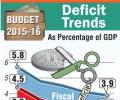
Finance Minister Arun Jaitley presented the Budget today.

"Under different scenarios, we see the impact of higher crude prices ranging from $25 billion to a maximum of $50 billion on the oil import bill. The increase in the oil import bill will also affect the current account deficit," economic affairs secretary S C Garg said in a conference on Friday.

The fiscal deficit situation during April-May of the last fiscal was 37.5 per cent of the Budget estimates.

On September 4, at a time when the rupee was the worst performer among Asian currencies, Raghuram Rajan took charge as RBI's governor.

Any revision in gold import duty is unlikely to take place before the Budget, says finance ministry official.

'The government and the RBI have been playing a very good part in terms of inflation management.'
.jpg)
The country has enough forex reserves to meet the demand.

Still, it is not expected to gain much strength and will likely trade around Rs 63.00 to the US dollar by the end of April.

Don't be surprised if growth in the second half of the financial year drops below 4%, which is where it was in the year before the pandemic, warns T N Ninan.

Gold imports surged by 93.86 per cent year-on-year to $4.98 billion.

Some type of global shock adds to the allure of the dollar.

The Budget estimate for the fiscal deficit in the year 2009-10 is Rs 3,32,835 crore (Rs 3,328.35 billion). Last year 2008-09, the first two months of the fiscal had accounted for 54.9 per cent of the year's Budget estimate.

Exports in May 2012 stood at $24.77 billion.

The contraction in imports helped narrow trade deficit to $7.67 billion in August 2016

Saying that the country was passing through a deep economic crisis for the first time since Independence, BJP president Rajnath Singh on Monday said that the country needed a 'realistic' prime minister and not an economist like Manmohan Singh.
India's economy is projected to slow to 6.5 per cent in the fiscal year starting April but will remain the fastest growing major economy in the world as it fared better in dealing with the extraordinary set of challenges the globe has faced, the Economic Survey 2022-23 said on Tuesday. India's gross domestic product (GDP) growth of 6.5 per cent in 2023-24 compares with an estimated 7 per cent expansion in current fiscal year (April 2022 to March 2023) and 8.7 per cent in the previous year. Like the rest of the world, India too faced an extraordinary set of challenges in tightening financial conditions and supply chain disruptions from a prolonged war in Europe but "withstood them better than most economies", the annual document detailing the state of the economy said.
For the first eight months of the current financial year, the figure stood at Rs 7.17 trillion.

India's economy is in much better shape to weather tighter U.S. monetary policy.

Prime Minister Singh has assigned a senior Congress leader to placate the President, who is upset with Finance Minister P Chidambaram, reports Anita Katyal.

Gold imports tick up 10.47% to $2.42 billion in May.

It is high time to manoeuvre the rupee more effectively and predictably, even as it has to be recognised that such tweaking of the rupee needs to be accompanied by reforms to the real sector and factor markets.

The challenge of achieving fiscal deficit targets for the next two years seems daunting.

The government has budgeted to cut the fiscal deficit to 3.3 per cent of GDP or Rs 6.24 lakh crore in 2018-19, from 3.53 per cent in the previous financial year.
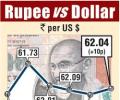
The currency's relatively stable performance even as the US announced tapering showed India's better preparedness to deal with any fallout of such foreign fund outflows.

Finance Ministry is expecting a rating upgrade by credit agencies by the year-end on the back of policy initiatives.

Longer-tenure FDs generally give higher returns. Nonetheless, going for a tenure higher than two to three years is not advisable.
 © 2026 Rediff.com - Advertise with us - Disclaimer - Privacy Policy - Sitemap - Feedback - About us - Terms of use - Grievances